Student Projects
Game Development:
From Logic to Worlds
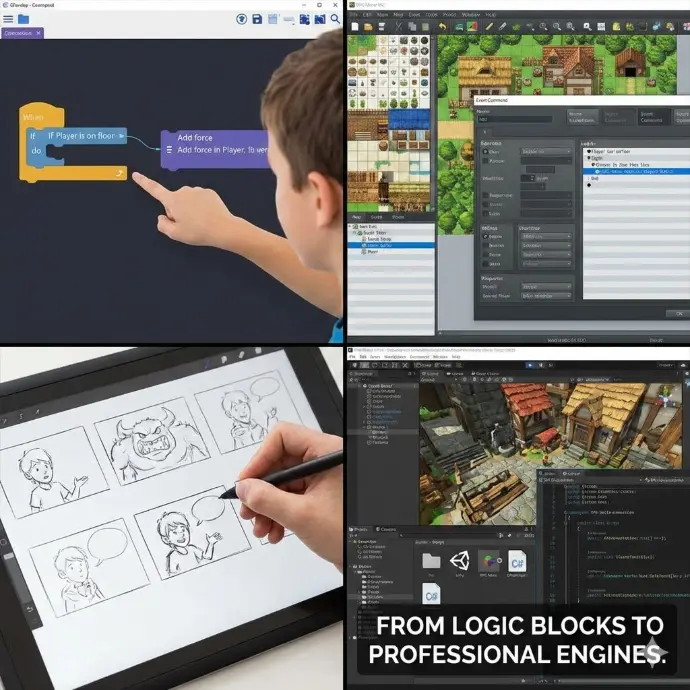
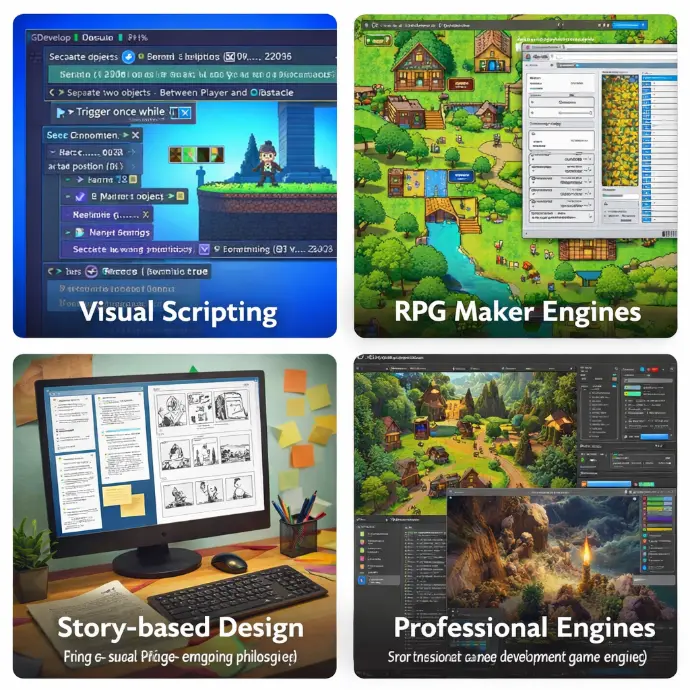
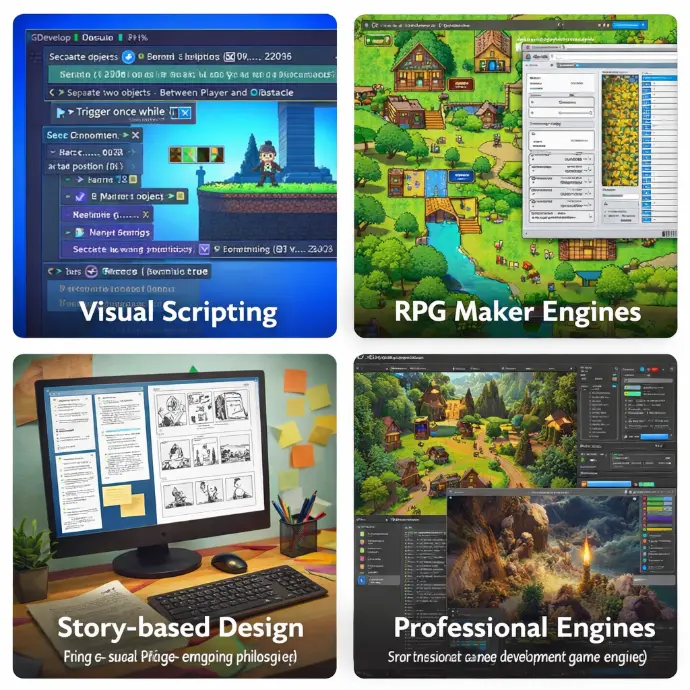
Our students progress through different tiers of game design. Starting with GDevelop to master event-based logic, they move into RPG Maker MZ/Unite for world-building and narrative design. Finally, they transition to Unity 2D, where they write C# scripts to create complex, multi-layered RPG experiences.
AI Mastery:
Prompting & Pipelines
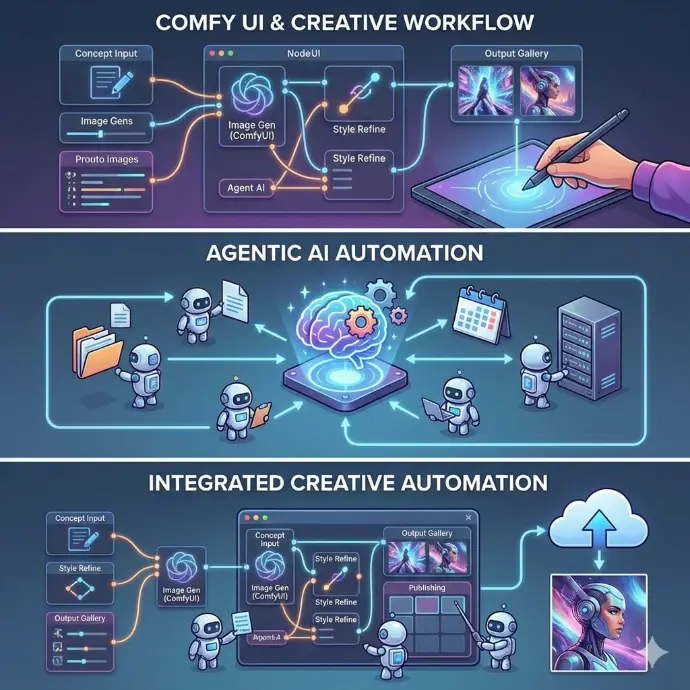
This section features AI-generated art and automation workflows. Using ComfyUI, students learn node-based logic to create complex image generation pipelines. They don't just "ask" AI for a picture; they build the architecture that controls the style, composition, and consistency of the output.
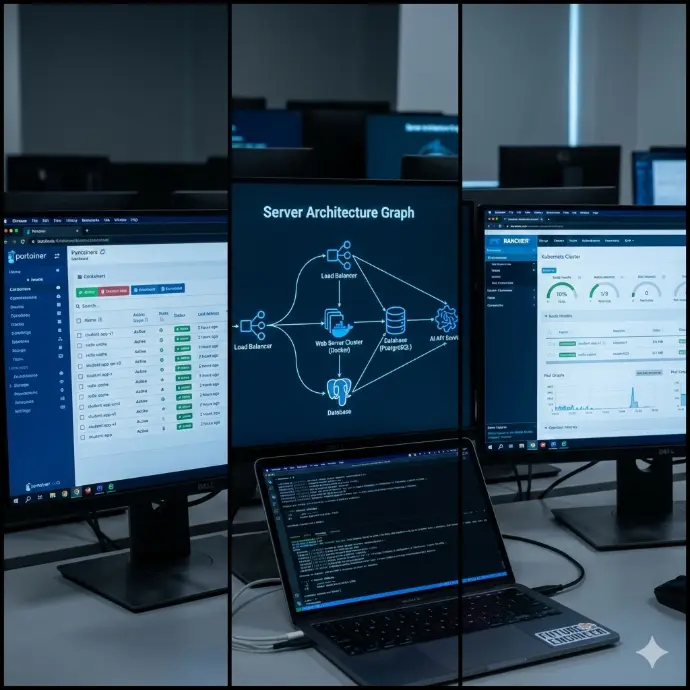
Infrastructure:
The Engines of the Internet
Every great app needs a home. Here, we showcase the backend architecture built by our students. Using Portainer and Rancher dashboards, students manage Docker containers and Kubernetes clusters. Our Server Architecture Graphs illustrate how they connect databases, web servers, and AI APIs into a single, scalable ecosystem.
From Gamer to Game Maker (Explorer Level)
The Case of the Impossible Maze
Problem
8-year-old Min was spending hours playing mobile games but would get frustrated and quit whenever a level became difficult. He had a "fixed mindset"—believing he just wasn't "good" at games.
Solution
We introduced him to Scratch Logic. Using our Backward Learning method, we showed him the code of his favorite maze game first. He realized the "difficulty" was just a series of if-then blocks he could control.
Outcome
Min built his own 5-level gravity maze. He no longer sees a difficult level as a reason to quit; he sees it as a logic puzzle to be re-coded. He gained the confidence to say, "I can build this better."
The 11-Year-Old SysAdmin (Builder Level)
Hosting the Future
Problem
Su wanted to share a Python project she built with her friends, but she didn't understand how the internet worked. To her, "The Cloud" was a mystery, and her code only lived on her laptop.
Solution
We taught Su the basics of Docker and Portainer. She learned how to "containerize" her application and deploy it onto a local server (HomeLab). She moved from just writing code to managing Infrastructure.
Outcome
Su successfully hosted her own mini-website and game server. She now understands the "Server-Client" relationship and has developed Real-World Resilience by troubleshooting network errors like a professional.
The AI Innovator (Creator Level)
The Smart Study Assistant
Problem
15-year-old Kyaw had thousands of digital school notes but struggled to find information quickly. He wanted an AI that knew his specific lessons, not just general internet facts.
Solution
Kyaw embarked on an Advanced AI Quest. He learned to use AI APIs and RAG (Retrieval-Augmented Generation) to build a custom AI tutor. He used Linux CLI to automate the data processing of his PDF notes.
Outcome
He built a functional "Personal Study Bot" that answers questions based on his own notes. This project became the centerpiece of his University Portfolio, proving he can build complex, AI-driven solutions to real problems.
Parent Testimonials
"I used to worry about my son’s screen time being 'wasted.' Since joining this program, he doesn't just play games—he critiques their logic and tries to rebuild them in Scratch. He’s stopped being a consumer and started being a creator."

"I was honestly shocked when my 11-year-old daughter started explaining 'Docker containers' and 'Portainer' to me. She successfully hosted her own game server at home! The confidence she gained from managing her own infrastructure is incredible."

"The level of tech my teenager is learning here is really good. Seeing him navigate Linux CLI and build AI automation projects using RAG makes me feel so much better about his career future. He is building a portfolio that stands out."

"The teachers here don't just spoon-feed information. They spark curiosity. My child comes home asking 'Big Questions' and researching answers himself. It’s the first time I’ve seen him this excited about learning anything."

"My son used to be terrified of making mistakes. Now, thanks to the quest-based learning style, he sees 'bugs' as just another level to beat. He’s developed a 'not scared to fail' mindset that has improved his schoolwork and his hobbies."

"It's not just about computers; it's about people. My daughter loves the peer collaboration sessions. She has learned how to explain complex ideas to her friends and how to work as a team to solve high-stakes challenges."